
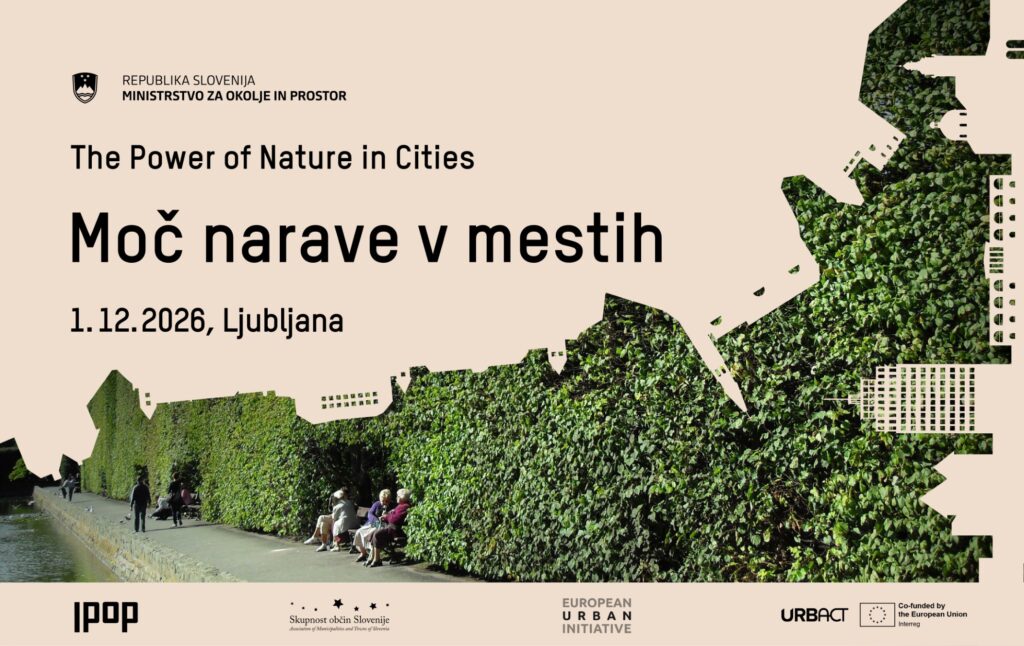
The Power of Nature in Cities
Nature restoration, Heritage and Community
Tuesday, 1 December 2026
Faculty of Social Sciences, Kardeljeva ploščad 5, Ljubljana
Climate change, increasingly frequent heatwaves, growing threats to nature and human health, and the loss of biodiversity are reshaping the challenges cities and local communities need to address. As pressure on public and open spaces continues to grow, urban greening is becoming increasingly important in creating more resilient, healthy and liveable cities. The conference will explore how cities and municipalities can translate nature restoration in urban areas from strategic objectives into concrete, feasible and socially supported measures.
The conference will explore how restoring and strengthening urban nature can go hand in hand with protecting cultural heritage, two closely connected aspects of urban planning that call for integrated approaches and collaboration among those involved in planning and managing our cities. Through examples of good practice from Paris and Graz, expert contributions and a roundtable discussion on experiences from Slovenia, we will explore the importance of dialogue and collaboration among different stakeholders in planning quality urban areas. We will explore how cities can bring nature restoration, cultural heritage and climate resilience together to create healthier, more resilient and liveable urban areas.
Particular attention will be given to the Slovenian National Nature Restoration Plan and to the practical challenges Slovenian municipalities face when planning and managing public and green public spaces, particularly where proposed solutions need to be aligned with cultural heritage protection.
The conference is an opportunity for networking and exchange of experiences among representatives of local communities, state institutions, experts in spatial planning, urban development, nature conservation, cultural heritage, climate policy and communication, as well as everyone involved in shaping greener and more resilient cities.
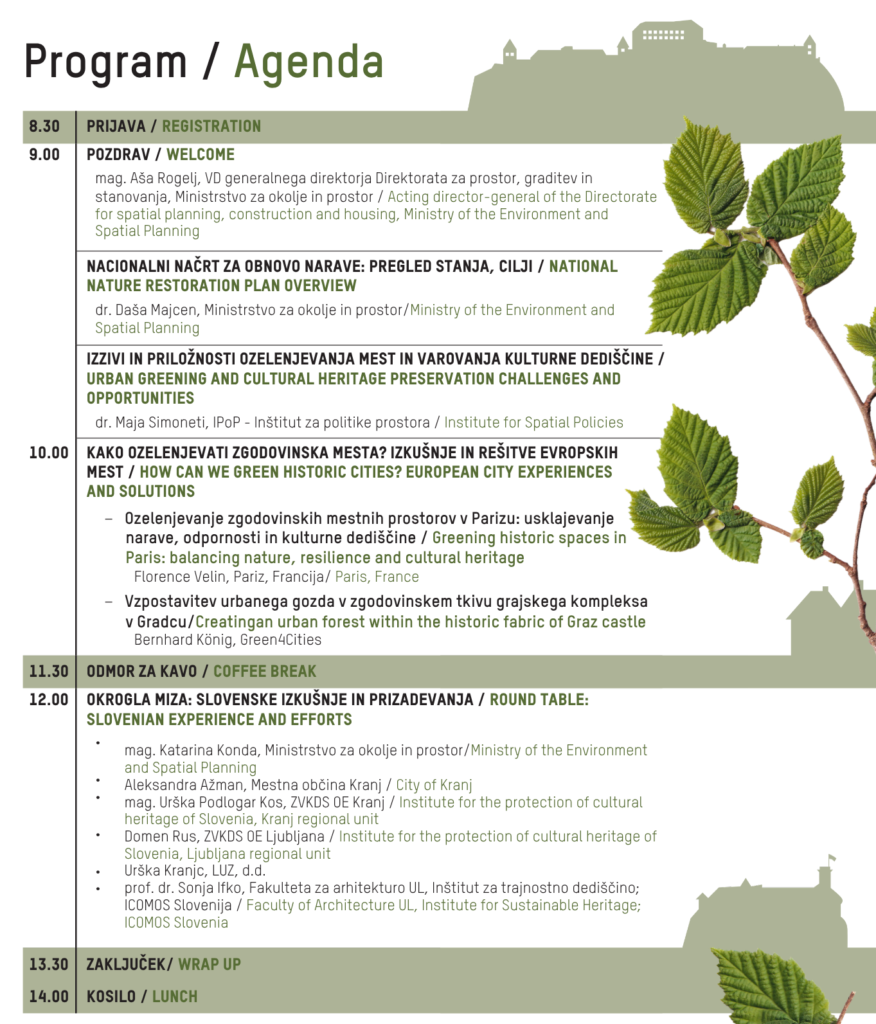
The conference is moderated by Ana M. Ličina. The round table is moderated by dr. Maja Simoneti, IPoP.
Attendance is free. The conference will take place in Slovenian and English with simultaneous interpretation.

Florence Velin
Florence Velin is an architect by training and has worked for the City of Paris on urban planning issues for over 20 years. She oversaw planning approvals across several parts of the city before serving as project manager for major regeneration schemes on its fringes. In that role, she worked with local stakeholders to refurbish social housing, schools, and other public services.
She now brings this experience to her post at the city’s Urban Ecology Agency, helping to implement the new bioclimatic urban plan adopted in 2024 (PLU-b), which places climate and biodiversity at the heart of urban planning. Working with colleagues who specialise in biodiversity and public participation, she contributes to the city’s greening strategy through key policy frameworks on tree cover, biodiversity, and sustainable food systems.
Bernhard König
Bernhard König is a landscape architect, managing partner of Green4Cities GmbH and member of the Breathe Earth Collective. He studied architecture, urban and regional planning in Weimar, Oxford and Zurich. After working for international design practices, he was a researcher at Graz University of Technology.
Green4Cities GmbH was originally established as a company focused on the practical implementation of applied research in green and blue infrastructure. It develops and designs pioneering solutions for creating sustainable and livable cities in the face of climate change.
The conference is organised by the Ministry for the Environment and Spatial Planning as part of the project Support for the Implementation of Spatial and Urban Policy and the URBACT Programme, implemented by IPoP – Institute for Spatial Policies and the Association of Municipalities of Slovenia. The participation of one international expert is co-funded by the URBACT Programme and the European Urban Initiative.
Graphics: Martin Naranđa

